
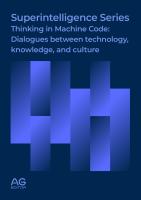
Superintelligence Series Volume 2: Thinking in Machine Code: Dialogues between technology, knowledge, and culture
Keywords:
Artificial IntelligenceSynopsis
There are moments when history pushes us forward with force—out of the known, the comfortable, the “way things have always been done.” It places us before a new reality that does not ask for permission to emerge, to transform everything, and to leave us with questions that have no immediate answers. Artificial intelligence is one of those moments. And this book is one of its responses.
Thinking in Machine Code: Dialogues between technology, knowledge, and culture does not mean ceasing to think as humans. It means daring to imagine new ways of knowing, teaching, learning, and living together in this accelerated era. This book is, precisely, an invitation to face that transformation—without fear, without denial, but also without naïveté.
Here you will not find magic formulas. What you will find is something much more valuable: real experiences, committed research, deep reflections, and concrete results born from the collaborative work of people willing to unlearn in order to learn again. Each chapter is a testimony to that courage.
This is not a book written from the center of the world, but from the South—from our universities, schools, classrooms, networks, and territories. From our accents, urgencies, questions, and possibilities. We speak here from and for Latin America, with everything that entails: creativity in scarcity, innovation from the community, and ethics rooted in reality rather than in the laboratory.
And if this book exists, it is thanks to many wills converging on a common desire: to think together. For this reason, we express our heartfelt gratitude to all colleagues who responded to the PLAGCIS call. You did not simply answer an invitation—you joined a collective commitment.
This book was not built through imposition but through resonance—through mutual listening, interdisciplinary dialogue, and intellectual generosity. Without you, none of this would have been possible.
We hope that every reader who opens these pages feels they are not alone in the transition toward the new. May this work be an extended hand, a possible map, a spark that ignites the desire to innovate with meaning, ethics, and care. Because yes—artificial intelligence may seem complex, but this book proves that it can also be human, creative, and profoundly transformative when placed in the service of the common good.
Welcome to this journey. We are already thinking in machine code… but with a Latin American heart.
Downloads
Published
January 1, 2025
Copyright (c) 2025 Daniel Román-Acosta, Guillermo Alejandro Zaragoza Alvarado (Volume editor)

Details about this monograph
ISBN-13 (15)
978-9915-9851-2-1
How to Cite
1.
Román-Acosta D, Zaragoza Alvarado GA, editors. Superintelligence Series Volume 2: Thinking in Machine Code: Dialogues between technology, knowledge, and culture [Internet]. AG Editor; 2025 [cited 2025 Dec. 7]. Available from: https://books.ageditor.org/index.php/books/catalog/book/978-9915-9851-2-1